- +8618937185591
- +8618937185591
- ec19@zkcorp.com
- +8618937185591


Project Overview
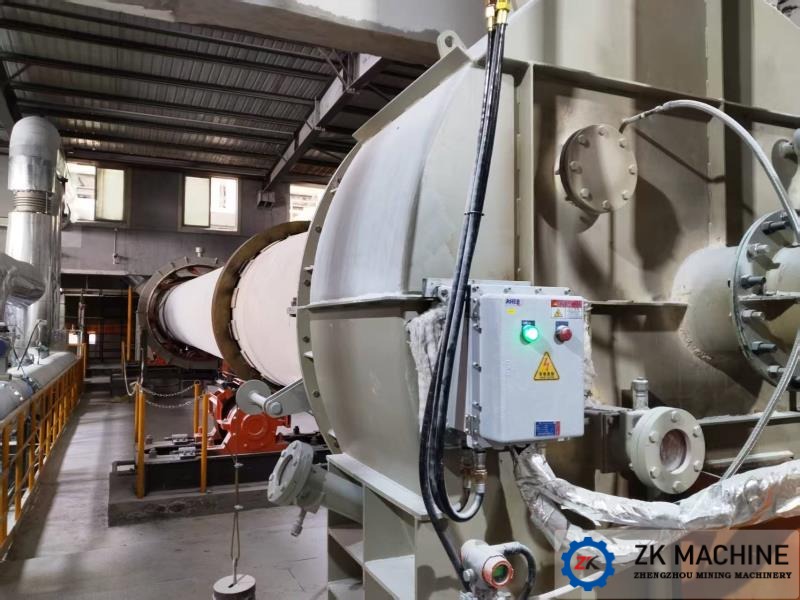
This project adopts a complete calcination plant equipped with a Φ1.6×20m rotary kiln for producing magnesia via magnesium hydroxide calcination. Centered on the thermal decomposition and calcination process of magnesium hydroxide to manufacture high-purity magnesia, it delivers a customized fully automatic rotary kiln calcination production line to satisfy demands for harmless, high-efficiency and energy-saving calcination of powdery and granular magnesium hydroxide feedstock.
The production line features a continuous calcination mode, suitable for magnesium hydroxide raw materials with particle size ≤10 mm, and boasts a stable designed capacity of 500 kg/h, enabling continuous and large-scale conversion from magnesium hydroxide to high-activity magnesia.
The integrated system combines multiple functional modules including material conveying, precision calcination, waste heat recovery, sealed dust collection, intelligent temperature control and stable transmission. It addresses prevailing industrial pain points of traditional magnesia calcination processes: inaccurate temperature regulation, excessive energy consumption, severe equipment vibration, on-site dust emission and unstable finished product qualification rate. Featuring high production efficiency, stable operation and outstanding energy conservation & environmental protection performance, it serves as an optimal complete plant solution for small-and-medium high-purity magnesia manufacturers.
Core Material & Equipment Parameters
1. Core Material Specifications
Raw Material: Magnesium Hydroxide
Raw Material Particle Size: ≤10 mm, uniform granules free of large impurities, compatible with continuous feeding and calcination in rotary kilns
Target Product: High-activity Magnesia (Extra Light Calcined Magnesia)
Designed Capacity: 500 kg/h. Operating parameters can be fine-tuned according to raw material moisture content and process requirements to guarantee stable and high output.
2. Core Equipment Specifications
Core Equipment: Complete Φ1.6×20m Industrial Rotary Kiln Unit
Supporting Systems: Automatic feeding system, intelligent combustion & temperature control system, waste heat recovery system, sealed dust collection system, hydraulic transmission system, finished product discharging system
Process Solution
Complete Calcination Process Flow
The project implements continuous rotary kiln calcination with fully automatic closed-loop operation. The whole process from raw material pretreatment to finished product discharge is fully controllable, detailed as follows:
Raw Material Pretreatment & Feeding
Magnesium hydroxide stored in the workshop undergoes screening to remove oversize particles and impurities, strictly limiting raw material particle size within 10 mm to meet feeding standards for calcination. Qualified feedstock is uniformly, quantitatively and continuously fed into the rotary kiln via variable-frequency feeding equipment. The variable-frequency feeding mode matches the calcination rhythm inside the kiln, eliminating material accumulation and feed interruption to lay a solid foundation for stable calcination.
Zoned Calcination Inside Kiln
As the kiln rotates at a low and constant speed, materials advance slowly along the axial direction and sequentially complete preheating, dehydration, thermal decomposition and maturation. Supported by the system’s intelligent temperature control program, the internal kiln temperature is precisely stabilized to meet magnesium hydroxide calcination requirements. High-temperature pyrolysis enables thorough decomposition of magnesium hydroxide to remove crystal water and convert it into high-purity, high-activity magnesia. Minimal temperature fluctuation avoids over-sintering from excessive heat or incomplete decomposition under low temperature, ensuring uniform and thorough calcination of all materials.
Waste Heat Recovery & Heat Exchange
High-temperature flue gas generated by calcination is discharged from the kiln tail, instead of being vented directly to waste heat. The flue gas enters a multi-stage waste heat exchange system to recover residual heat via heat exchangers. Recovered heat can be reused for raw material preheating, auxiliary kiln thermal insulation and workshop heating, realizing cyclic thermal utilization, drastically cutting fuel consumption of the whole plant and boosting energy efficiency. Cooled flue gas is then sent to the dust purification system for treatment.
Finished Product Discharging & Post-Treatment
Calcined magnesia is conveyed to the kiln head discharge end with kiln rotation, cooled by cooling equipment and smoothly discharged via discharging devices. Finished products can be directly transported to finished silos for storage, or further screened and packaged as required. Fully calcined finished magnesia features consistent purity and stable activity with an extremely high qualification rate.
Environmental Dust Removal
Dual guarantees of kiln sealing structure and post-stage dust collection system are deployed throughout production. Trace dust escaping from the kiln and particulate impurities contained in flue gas are fully captured and purified before reaching emission standards. This greatly optimizes the workshop environment and complies with environmental production regulations.
Core Project Highlights & Technical Advantages
1. Mature & Stable Process with Superior Finished Product Quality & High Qualification Rate
The standardized optimized calcination process adapts to the calcination characteristics of magnesium hydroxide ≤10 mm, with perfectly coordinated feeding, calcination and discharging rhythms. Materials are evenly heated and fully reacted inside the kiln, fundamentally resolving common defects of traditional processes such as incomplete calcination, insufficient magnesia activity and high impurity content. The finished magnesia maintains stable purity and activity with an industry-leading overall yield, satisfying high-end application demands across multiple sectors including industrial refractory materials, chemical raw materials and environmental water treatment.
2. Intelligent Precision Temperature Control with Industry-Leading Accuracy
Equipped with a fully automatic intelligent combustion temperature control system, the unit monitors real-time temperatures of each kiln zone according to preset calcination parameters, and automatically adjusts flame size, combustion power and air intake to achieve dynamic and precise internal kiln temperature regulation with a control accuracy of ±2°C. Compared with conventional manual and rough temperature control, it avoids finished product performance deviations caused by drastic temperature swings, ensures consistent product performance batch by batch and drastically reduces reject rates.
3. Multi-Stage Waste Heat Recovery Delivers Remarkable Energy Saving
Targeting the high energy consumption and severe waste heat loss of traditional rotary kiln calcination, this project integrates a multi-stage heat exchange waste heat recovery system. High-temperature kiln tail flue gas transfers heat through multi-layer heat exchange structures, recovering waste heat for cyclic reuse in production processes to maximize thermal recycling efficiency. It effectively cuts fuel consumption and energy waste, greatly lowering project operating costs while delivering economic and energy-saving benefits in line with green low-carbon production standards.
4. Composite Transmission Structure Ensures Stable & Durable Equipment Operation
The rotary kiln innovatively adopts a combined mechanical-hydraulic roller support structure, replacing conventional single mechanical roller designs. Mechanical rollers guarantee basic structural stability, while hydraulic rollers automatically adjust axial kiln creep, buffer operational vibration and offset mechanical wear stress. The entire transmission structure bears uniform loads and runs smoothly, effectively reducing equipment noise and component abrasion, extending service life, lowering downtime due to breakdowns and subsequent maintenance costs, and adapting to long-term continuous production conditions.
5. Multi-Layer Sealing Design Delivers Excellent Dust Suppression & Environmental Performance
Composite sealing consisting of flake seals and labyrinth seals is installed at both kiln ends. The dual sealing structures work synergistically to tightly block kiln gaps and drastically reduce air leakage. It prevents cold ambient air from entering the kiln to disrupt calcination temperature and raise energy consumption, while completely restraining internal dust escape, eliminating unorganized dust emissions at the source, vastly improving workshop working environments and enabling clean production in compliance with environmental norms.
Project Operation Performance
After commissioning, the complete plant runs stably with high automation and minimal manual intervention, supporting 24-hour continuous production. The designed capacity of 500 kg/h is consistently achieved, yielding magnesia with uniform quality and high qualification rates. The intelligent temperature control system standardizes production processes and greatly improves batch stability of finished products. The waste heat recovery system effectively cuts production energy consumption and optimizes operating costs significantly. Characterized by low vibration, low dust and low failure rates, the equipment boosts production efficiency and improves workshop conditions, fully fulfilling production targets of high output, energy conservation, environmental friendliness and stable operation. It provides an efficient and reliable complete production solution for small-and-medium magnesia manufacturers.
Previous:none
Next:1 Million Tons Annual Lump Ore Drying System Project in Tongling, Anhui
Fast, professional and reliablewe provide you with services throughout the product ...

Email
ec19@zkcorp.com

Whatsapp
+8618937185591
Fast, professional and reliablewe provide you with services throughout the product . you with services t


