- +8618937185591
- +8618937185591
- ec19@zkcorp.com
- +8618937185591


I. Project Overview:
Project Address: Gucheng County, Hebei
Product Name: Production Line for Oil Sludge Heat Treatment Conversion Device
Service Scope: Comprehensive technical services including process design, equipment supply, installation and commissioning, and after-sales training for systems such as feeding, mixing and pelletizing, drying, calcination, cooling, finished product conveying, environmental dust collection, desulfurization and denitrification, and electrical automation control.
II. Project Description
CNOOC Energy Conservation and Environmental Protection Service Co., Ltd. is constructing a production line for oil sludge heat treatment conversion devices in Gucheng County, Hebei. The project aims to achieve reduction, harmlessness, stabilization, and resource utilization of oil sludge by converting drilling oil sludge into ceramsite.
III. Process Description
The production process is as follows: Oil sludge ton bags → Pre-treatment → Mixing → Granulation → Preheating → Roasting → Cooling → Finished product.
3.1 Raw Material Pre-treatment
After natural drying in the warehouse for a certain period to evaporate some moisture, the clay undergoes stone removal via a stone remover before mixing.
3.2 Granulation
The mixed materials are extracted by a stacker-reclaimer and fed into a feeder. The feeder delivers the materials to a twin-shaft mixer for blending. After mixing, the moisture content of the materials is 15–25%, and they are then sent to a granulator for pelletizing. The raw pellets are transported via a steeply inclined belt conveyor to the feed pipe at the top of the kiln tail chamber and enter the rotary kiln.
3.3 Preheating, Roasting, and Cooling
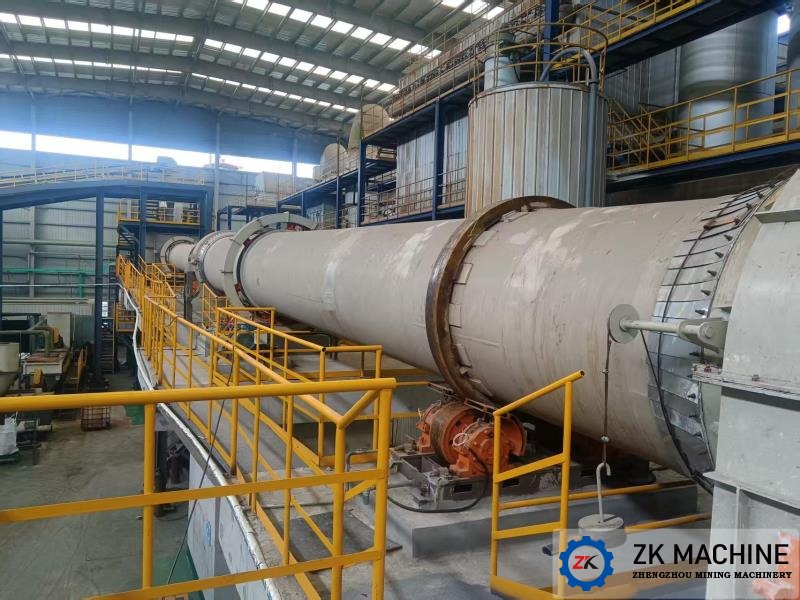
The raw pellets are quantitatively fed into the socket-type rotary kiln by the kiln tail feeding device. The socket kiln consists of a preheating kiln and a calcining kiln, both driven by variable frequency speed control and rotating independently at their respective speeds. All connection points are equipped with fish-scale seals to prevent the leakage of flue gas and dust through negative pressure in the kiln and the fish-scale sealing system.
Inside the rotary kiln, the pellets gradually move toward the kiln head as the kiln rotates, while high-temperature gas flows from the kiln head to the kiln tail. During movement, the pellets exchange heat with the high-temperature flue gas (conduction, convection, radiation). Their temperature gradually rises, and physical and chemical changes occur inside. Oxidation-reduction, dehydration, and carbonate decomposition take place, generating gas that causes rapid expansion of the pellets. At high temperatures, a liquid phase forms on the pellet surface, sealing internal pores to form ceramsite.
3.4 Cooling and Finished Product System
The high-temperature ceramsite after roasting enters a single-tube cooler. Under the negative pressure at the kiln head of the rotary kiln, cold air is introduced from the discharge end of the cooler. The ceramsite cools upon contact with the cold air, forming a glazed surface.
The cooled ceramsite is transported by a bucket elevator to the finished product silo and subsequently shipped from below the silo.
IV. Main Equipment Supplied
No. | Name | Model | Quantity |
1 | Drying Kiln | YM1220 | 1 unit |
2 | Calcining Kiln | YM1618 | 1 unit |
3 | Cooling Kiln | LJ1518 | 1 unit |
Fast, professional and reliablewe provide you with services throughout the product ...

Email
ec19@zkcorp.com

Whatsapp
+8618937185591
Fast, professional and reliablewe provide you with services throughout the product . you with services t


